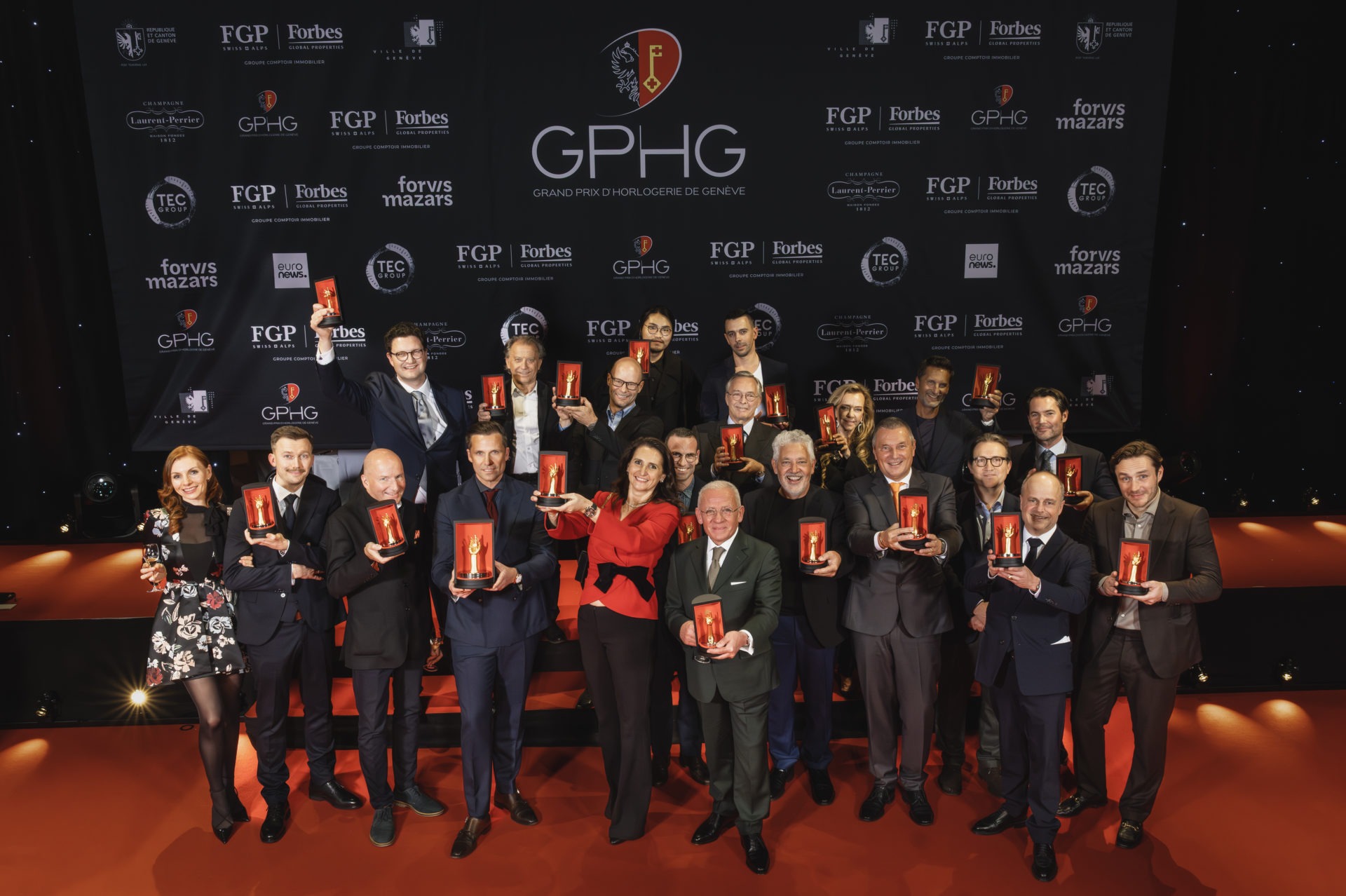
On 13 November 2025, Haute Horlogerie gathered for the 25th edition of the Grand Prix d’Horlogerie de Genève. In the  Bâtiment des Forces Motrices, this emblematic power station on the banks of the Rhone, the anniversary edition of the world’s most important watch award ceremony took place. Raymond Loretan, President of the GPHG, opened the evening with a reference to the location itself: “This emblematic site perfectly reflects the spirit of watchmaking art – the connection between art and industry, mechanics and poetry, mystery and mastery of the microscopic, the pursuit of the infinite.”
The GPHG has developed over a quarter of a century into the leading institution that honours and promotes watchmaking art. Five years ago, the Academy was founded, which today counts over 1,000 members worldwide. It is they, together with the jury, who determine the winners. Watchmaking art itself has been recognised by UNESCO as intangible cultural heritage of humanity – a status that underlines the importance of this craft.
On this evening, 20 prizes were awarded in various categories. From entry-level watches under 3,000 Swiss francs to the highest award, the Aiguille d’Or, the spectrum covered the entire range of contemporary watchmaking art.
Prix Challenge – Dennison and the Renaissance of a Brand

The Prix Challenge, which honours watches under 3,000 Swiss francs, went to Dennison for the model “Natural Stone Tiger Eye in Gold”. Stéphane Tschök and Toby Sitton accepted the prize. The brand was revived exactly one year ago, on 22 October 2024 – an old English watch brand brought back to life. “A lot of work, but what a pleasure,” Tschök summarised. The design is by Emmanuel Gate. The team is small – only five people – but the passion is great. Sitton had secured the brand at the age of 21, with the vision of reviving it one day. After almost 20 years, this moment had arrived.
Petite Aiguille – MB&F MAD 2 Green
The Petite Aiguille category – named after the small hand indicating the hours – went to MB&F for the MAD 2 Green. Maximilien Büsser, founder and Creative Director of MB&F, accepted the prize. “This brand should never have existed,” explained Büsser. Five years ago, the idea arose because all the people important to him – childhood friends, family – could not afford an MB&F. So  500 pieces were made for “Friends & Family”. Then social media picked up on the topic. Today, MAD Edition has become an independent brand that Büsser had not originally planned.
The design of the MAD 2 Green is a tribute to the legendary MAD Nightclub in Lausanne, with mixing disc and strobe lights as design elements. Büsser especially thanked Eric Giroux, his companion for over 25 years. “Eric, if you hear us, if you see us – this prize belongs to you.”
Montre de Sport – Chopard Alpine Eagle

The prize for the sports watch went to Chopard for the Alpine Eagle. Karl-Friedrich Scheufele described it as “a very family project”, on which father, son and he himself worked. Three generations of Scheufele united in one watch – a fitting winner for the sports category, which combines robustness with elegance.
## Montre Chronographe – Angelus
 Angelus won with the Chronographe Télémètre. The telemeter function, once used for distance measurement during thunderstorms or in military applications, finds here a modern interpretation in a classic chronograph case.
Montre Iconique – Audemars Piguet Royal Oak Perpetual Calendar
The “Iconique” category honours watches that have shaped watch history for at least 20 years. 2025 
 went to Audemars Piguet for the Royal Oak Perpetual Calendar 26674 – the Royal Oak was designed by Gérald Genta in 1972. The prize came in the year of Audemars Piguet’s 150th anniversary. CEO Ilaria Resta accepted the award. Brice Lechevalier, publisher of GMT Magazine, presented the prize and pointed out that both the GPHG and GMT Magazine celebrate their 25th anniversary this year. The Royal Oak remains “a cornerstone in the art of dial design” and inspires the entire industry to this day.
Complications pour Femmes – Chopard Imperial
 In the women’s complications category, Chopard won with a watch from the Imperial Collection. Caroline Scheufele, Co-President of Chopard, called her brother Karl-Friedrich to the stage, as the watch unites both their competences: Karl-Friedrich’s L.U.C. manufacture movement and Caroline’s jewellery expertise. “It is the first time that a women’s complication from Chopard has won such a prize,” Karl-Friedrich proudly explained.
The complication is poetic: a hand-carved dial shows the four seasons, which are passed through over the course of a year. A disc, crafted by Métiers d’Art artisans, rotates once per year and reveals three colours – one for each season. The watch transforms over the year. Diamonds and jewellery work, Caroline’s specialty, are added. A technical and artistic masterpiece in one.
Métiers d’Art – Kari Voutilainen
The prize for Artistic Crafts was won by Kari Voutilainen. Jack Carlson, American jury member and CEO of his eponymous 
 brand, presented the award with humorous reference to his role as “token American on the jury”. He praised the finalists as “a celebration of colour and texture”, showing that craftsmanship and fun can indeed be combined.
Voutilainen thanked for the choice of this “very special watch”. The centerpiece is a GMT complication with unusual operation: by pressing the crown, the central disc moves – technically a small challenge. But the true art lies in the dial. Voutilainen worked with M. Kitamura from Japan, “who is regarded as the best in his field worldwide”. The connection came about through Masato Hayashi, a long-time friend and former student of Voutilainen. The dial unites Japanese lacquer technique, gold powder and leaves, as well as other materials, into a work of art that adorns an exquisitely decorated movement.
Montre pour Homme – Urban Jürgensen UJ-2
The men’s watch category was won by Urban Jürgensen with the UJ-2: Double Wheel Natural Escapement. The brand celebrates its 250- th anniversary. But the real highlight is hidden inside: the movement was created by Kari Voutilainen and his team in Biel. “We actually honour the work that Kari and his incredible team have done,” explained the Urban Jürgensen spokesperson at the award ceremony.
The watch combines inspiration from the past with modern execution. “It was a challenge for me and the team to create something timeless and yet always modern – and not a copy of something already existing.” The design codes of the Jürgensen family are visible in the movement, but the creativity of the movement is completely contemporary. Urban Jürgensen is over 250 years old, but “we are just beginning this next chapter”.
Joaillerie – Dior La D de Dior Buisson Couture
 The jewellery watch prize was won by Dior with the La D de Dior Buisson Couture. The watch combines Haute Joaillerie with watchmaking art at the highest level.
Time Only – Daniel Roth Extra Plat Souscription

The Time Only category, which honours watches that focus solely on time display, was won by Daniel Roth with the Extra Plat Souscription Rose Gold. A watch that convinces through reduction and elegance.
Montre pour Femme – Gérald Genta Gentissima Oursin Fire Opal
 Montre pour Femme – Gérald Genta Gentissima Oursin Fire Opal
The prize for the women’s watch went to Gérald Genta for the Gentissima Oursin Fire Opal. The organic shape of a sea urchin (Oursin) was set with fire opals – an elaborate process of faceting, polishing and individually setting each stone. The Fabrique du Temps and its craftsmen created an exceptional piece of jewellery.
Complication pour Homme – Bovet Récital 30
The prize for the men’s complication went to Bovet for the Récital 30. Pascal Raffy, President of Bovet, accepted the award  visibly moved. “The Récital 30 was born in the middle of the pandemic,” he explained. As video conferences across continents became the norm, the problem of wrong time zones and times arose regularly. From this everyday experience, the idea emerged: a universal time display that absolutely precisely depicts the “Daylight Saving Time Issue” – the four phases of the year with their time changes.
After six years of development, the result is astonishing: 25 rollers rotate by 90 degrees and show the correct city in the correct time zone for each phase of the year. “That is really a very beautiful achievement,” said Raffy. Moreover, the Récital 30 is the first case entirely manufactured in the Bovet manufactory. Raffy had just returned from a world trip – from Zurich via Hong Kong, Kuala Lumpur, Singapore, Bangkok, Taipei, Tokyo to Mexico, Las Vegas, Palo Alto, Oklahoma City, New York and back to Switzerland. “The Récital 30 is a daily companion. It is useful, it is versatile.”
For the 203-year-old Bovet manufactory, this watch marks a turning point towards a more modern identity. Raffy thanked his three children Audrey, Alexandra and Amadeo for the “freshness” of the design: blue for the sky, yellow for the sun, and a vintage touch that he “deeply loves”.
## Exception Mécanique – Greubel Forsey
The prize for mechanical exception went to Greubel Forsey. CEO Michel Niedegger took the microphone with humorous self-irony: 
“I am here to take most of the credit for the work of others – work to which I have contributed nothing, which I only partially understand, but which I deeply respect and admire.” The award, he emphasized, belongs to the 130 watchmakers, finisseurs and engineers of Greubel Forsey, “who always dream big and will continue to do so.” The award-winning watch features a Foudroyante complication – an extremely rare function that divides each second into six segments, while simultaneously consuming incredibly little energy. “A revolution, a true mechanical exception,” as the laudation stated. Niedegger thanked Robert Greubel and Stephen Forsey for their vision and their never-ending demand for expertise and excellence. With a wink, he concluded by thanking Mark Zuckerberg: In an era of automation, bits and bytes, the Foudroyante proves that “real mechanics and poetry will always have a place.”
Tourbillon – Bulgari Octo Finissimo Ultra
Bulgari won the Tourbillon category with the Octo Finissimo Ultra Tourbillon – the tenth finesse record for the brand. Jean-Christophe Babin, CEO of Bulgari and the LVMH Watch Division, accepted the prize. The Flying Tourbillon presents engineers with the challenge of “testing the physical limits without compromising reliability.”
For Babin, this prize was particularly emotional: “Not only because Bulgari wins, but because Mr. Sabu is a very good friend of mine.” Yasho Sabu, jury member and founder of Ethos & Taratec from India, presented the prize – with a remarkable speech about India’s growing importance for the watch industry.
Babin reflected on 25 years in the watch industry: “There probably won’t be another 25 years, because I’m getting old.” He thanked not only his colleagues at Bulgari, but also at Tag Heuer, his former brand, which he now leads again. Over 20 GPHG prizes have been won by these two brands together, including two Aiguilles d’Or. “In the year 2000, these brands were not really seen as legitimate,” he recalled. Thanks go to the jury and the academy for the trust that made this transformation possible.
Horloge Mécanique – L’Épée 1839 Albatross X MB&F
The mechanical clock – meaning the category for table and standing clocks – was won by L’Épée 1839 Albatross in collaboration with MB&F. The clock unites over 1,520 components, 16 pairs of propellers and an eight-day power reserve. “A masterful blend of mechanics and poetry,” as the laudation described it.
The Chinese presenters Shining Zhu (journalist) and Xu Zheng Cheng (collector and president of the Macao Watch Association) awarded the prize with a charming remark: “In China, you must never give someone a clock. But I don’t care, because… parce que je les aime tous!” (because I love them all!).
L’Épée thanked for 15 years of trust in the manufactory’s clocks, “when clocks were not yet quite in fashion.” Co-branding has a long tradition at L’Épée – the first collaboration was in the 1970s with Hermès. Maximilien Büsser of MB&F, who had already won the prize for the Petite Aiguille, thus won twice this evening.
## Prix de l’École – Édouard Lay
The prize for the best student of the first year at the École d’Horlogerie de Genève went to Édouard Lay. “It is an honour for  me to stand here on the stage of the Grand Prix d’Horlogerie de Genève,” said the young watchmaker. He thanked his close ones, his family, his friends and fellow students, as well as all professors. A youth prize that underlines the importance of training for the future of the industry.
## Révélation Horlogère – Anton Suhanov
The award for horological revelation – brands under ten years – went to Anton Suhanov. The prize is awarded to brands that have already developed a distinctive and unique voice. Previous winners were Rémy Cools, Sylvain Pinaud and Simon Brette. Suhanov, visibly surprised, explained: “This prize is not the last step, but the beginning of even harder work and greater challenges.” He thanked his wife for belief and support, his family, his colleagues and friends.
## Audace Horlogère – Fam Al Hut
The prize for horological boldness went to the Chinese brand Fam Al Hut for the Möbius. Quentin Epinet, founder and 
 CEO of Forbes Global Properties Swiss & Alps – the main sponsor of the GPHG – presented the prize. The jury praised “a rich mixture of styles and cultural references” as well as the integration of a double-axis and double-retrograde complication into a small volume at a moderate price.
Founder Daishin Yen (Chinese Dai Xingyan) introduced himself in Chinese and English: “I did not expect to win this prize. It is the first time our brand participates in the Grand Prix.” His message was clear: “We want to present the world with a different vision of ‘Made in China’.” The future? “We will continue to admire the pioneers of Swiss Haute Horlogerie and bring further remarkable creations.”
## Chronométrie – Zenith G.F.J. Calibre 135
The prize for ch ronometry – accuracy – went to Zenith for the G.F.J. Calibre 135. The brand has received over 2,000 prizes for precision since its foundation. “Receiving this prize for chronometry is an immense honour and a very special emotion for all teams of our manufactory,” explained the brand’s representative. “This prize is for you – for you and for all who still believe in the magic of time.”
## Prix Spécial du Jury – Alain-Dominique Perrin
The special jury prize went to Alain-Dominique Perrin. Jury President Nick Foulkes presented the award, which was accepted by a representative of Perrin. “This prize represents the recognition of an entire profession that I know well and have loved for a long time,” said the acceptance speech. Perrin, a key figure in the luxury industry, was honoured for his lifelong commitment to craftsmanship and creativity.
## Grand Prix – Aiguille d’Or: Breguet Classique Souscription 2025
The highlight of the evening: the Aiguille d’Or, the Grand Prix of the GPHG. The highest award went to Breguet for the Classique Souscription 2025. Grégory Kiesling, CEO of Maison Breguet, accepted the award. The watch won the Aiguille d’Or – and that with only a single hand. This is made of steel, blued, and adorns a dial of purist elegance.
“Receiving this Grand Prix for a watch that has only one hand – and that made of steel, albeit blued – is above all an immense honour and deep emotion,” began Kiesling. 2025 is a special year: Breguet celebrates 250 years of uninterrupted existence and history. “The highest award of the most prestigious watch competition rewards not only a watch, but an entire journey, built on savoir-faire and the passion of generations of men and women, without whom nothing would be possible.”
The Classique Souscription 2025 is inspired by the iconic Souscription pocket watch, launched in 1796 – immediately after the French Revolution. It thus holds a special place in the history of the manufactory. Despite its seemingly simple appearance, it embodies “one of the greatest challenges of modern watchmaking: simplicity.” It is often said that it is more difficult to create a reduced watch than a complicated one.
The Souscription is also a tribute to a simple and visionary idea by Abraham-Louis Breguet, the father of modern watchmaking: to create a watch based on trust, accessible to loyal customers and repairable anywhere in the world. “Honouring the Souscription more than two centuries later means reconnecting with its original spirit – a human, sincere watchmaking, animated by unique skill.”

The watch symbolizes the anniversary and embodies what enables the manufactory to still be here a quarter of a millennium later. It celebrates the connection between past and present, tradition and modernity – a bond that perfectly summarizes the theme of the anniversary year: “A heritage in motion.” “This prize celebrates not only a design, a movement, a page of our history or an anniversary,” concluded Kiesling. “It celebrates above all all those employees who, every day with passion and ambition, bring this Maison to life. Each contributes in their own way to turning an idea into reality, savoir-faire into emotion. It is thanks to this collective spirit, this community of talents, that Breguet continues to write its history.”
The 25th edition of the Grand Prix d’Horlogerie de Genève was a worthy conclusion to a quarter of a century. Raymond Loretan closed the ceremony with the words: “Gloire aux vainqueurs, honneur aux vaincus” – Glory to the winners, honour to the defeated. The winning watches will be exhibited from 19 to 23 February 2025 at the Dubai Watch Week.