
Like in the old days, just much more technical and very exciting
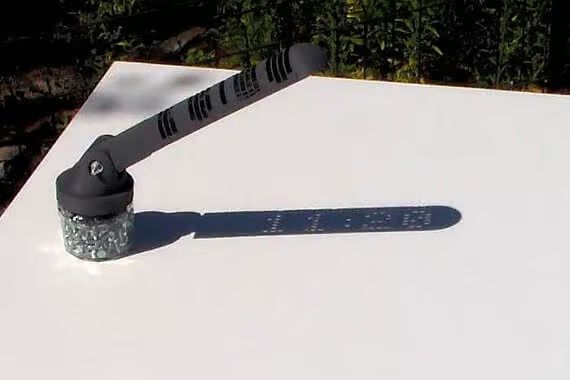
A sundial that doesn’t display time with a shadow on a scale, but with actual digits – like a digital clock. It’s pure mathematics and clever design. And the best part: one can make it oneself with a 3D printer. A good reason to take a closer look.
The principle: Mathematics meets sunlight
The digital sundial by Mojoptix – a French engineer named Julien Coyne – is a brilliant example of how simple physics and complex calculations can create something that looks like magic.

The centerpiece is the gnomon, that part of the sundial which casts the shadow. Only this gnomon in the digital version is perforated like Swiss cheese – and very precisely so. The shape was mathematically calculated so that the sun’s rays fall through exactly the right holes at specific times and angles.
The result: digits appear in the gnomon’s shadow, showing the current time. Between 10:00 and 16:00, in 20-minute increments. No battery, no electricity, no motor. Just the sun and a few thousand strategically placed holes.
How it works
One can imagine this as an analog pixel display. Each hole in the gnomon functions like a pixel. As the sun moves, its light falls through various combinations of these “pixels” and thus creates the digits in the shadow. The trick: The holes aren’t simply placed randomly, but arranged at different angles and positions. Mojoptix himself describes it as a “really super-fancy shadow show” – and that’s exactly what it is.

Particularly clever: one can adjust the time simply by rotating the gnomon. Daylight saving time? No problem. Just turn it a bit, done.
3D printing makes it possible
Until about ten years ago, such a sundial would have been practically impossible to manufacture. The complex geometry with its countless precisely angled holes could hardly have been produced with conventional methods.
3D printing changed that. Mojoptix published his design on Thingiverse as open source in 2015. Since then, thousands of makers worldwide have printed their own digital sundial.
The print takes about 30-35 hours and consists of four parts. Important: one should use ABS filament, not PLA. Because the sundial stands outside in the sun, and PLA deforms in heat. ABS withstands this better.
The limits of the technology
Naturally, this sundial also has its limitations:
It only works in sunshine (obviously)
It only shows the time from 10:00 to 16:00
The accuracy is 20 minutes
One needs different versions for the Northern and Southern hemispheres
And then there’s another peculiarity: To function throughout the year, the “pixels” would have to be extremely wide (to compensate for the changing position of the sun over the seasons). That would make the thing impractically large. Mojoptix’s solution: one must tilt the sundial up or down by about 10 degrees every six months.
What excites me about it
For me personally, this digital sundial is a perfect example of how old and new technologies can come together. The sundial itself is one of humanity’s oldest timekeeping technologies – the earliest examples date from 1500 BC.
And now, more than 3,500 years later, we use 3D printers and complex mathematical calculations to bring the same principle into a “digital” form. It’s somehow anachronistic and yet totally contemporary.
Additionally, this project reminds me of my fascination with mechanics and clever solutions. In watchmaking, it’s about mechanical solutions to physical problems. The digital sundial is the counterpart to that – just with light instead of gears.
For making yourself or buying
Anyone with a 3D printer can simply print the sundial themselves. The files are freely available on Thingiverse under the keyword “Digital Sundial by Mojoptix”. One still needs:
- An (empty!) jam jar (as weight and base)
- 3x M6 screws, flat head, length 20mm
- 1x M6 screw, flat head, length 50mm
- 4x M6 nuts
- 4x M6 washers
Important when printing: turn off the support structures! Otherwise they’ll clog all the small holes through which the light must fall.
Wer keinen 3D-Drucker hat, kann die Sonnenuhr auch fertig kaufen – auf Etsy gibt es sie für etwa 70-80 Euro.
Conclusion: When the sun ignites the pixels
The digital sundial is one of the coolest 3D printing projects I’ve seen in recent years. It combines mathematics, physics, modern manufacturing technology and ancient timekeeping tradition into something completely new.
And it shows once again: the most exciting things often emerge when established concepts are rethought in unconventional ways. Just like the independent watchmakers.
Only here it’s not a watchmaker spending years perfecting a masterpiece, but a French engineer catapulting the sundial into the 21st century with OpenSCAD software and a 3D printer.
No batteries, no motor, no electronics. Just a really super-fancy shadow show.
Links:
- Mojoptix Website: www.mojoptix.com
- Thingiverse Design: www.thingiverse.com/thing:1068443


